Introduction
Grant funding is both critical and intensely competitive for nonprofits. In the United States, 1,935,344 registered nonprofits compete for philanthropic dollars, with foundation giving alone reaching $109.81 billion in 2024.
Yet many organizations submit proposals that fail not because their programs lack merit, but because of avoidable mistakes: disorganized narratives, missing documentation, budget-narrative misalignment, or weak readiness signals that immediately disqualify otherwise strong applicants.
This guide walks nonprofit leaders through every stage of grant writing—from building organizational readiness and identifying aligned funders to crafting compelling proposals and managing post-award compliance. The strategies ahead will help you compete more effectively and secure the funding your mission deserves.
TLDR:
- Financial readiness (clean 990s, audits, board oversight) precedes successful applications
- Mission alignment and funder relationships matter more than proposal length
- SMART objectives and budget-narrative alignment build credibility
- Plain language and storytelling make proposals memorable
- Post-award compliance demands strong tracking, documentation, and reporting systems
Is Your Nonprofit Grant-Ready?
Grants are not free money. Every award comes with reporting requirements, financial accountability obligations, and compliance standards that organizations must be prepared to meet before submitting an application.
Funders assess organizational health first—often before reading a single word of your program narrative—by reviewing financial documents that signal competence, stability, and stewardship.
Core Organizational Readiness Checkpoints
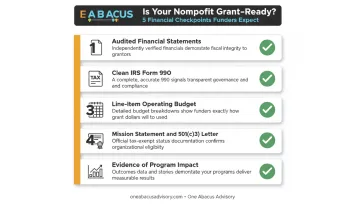
Funders evaluate readiness through five core checkpoints:
- Current audited financial statements — Demonstrates fiscal accountability and third-party validation of financial health; many funders require audits for grants above $50,000-$100,000
- Clean IRS Form 990 — Legally required for public inspection and routinely requested by funders; reveals giving patterns, compensation structure, and program spending ratios
- Line-item operating budget — Shows fiscal planning capacity and helps funders assess whether your request is realistic relative to organizational size and revenue
- Clear mission statement and 501(c)(3) determination letter — Confirms tax-exempt status and mission alignment with funder priorities
- Evidence of program impact — Quantitative and qualitative data showing that your programs achieve measurable outcomes, not just deliver activities
Financial Infrastructure as a Requirement
Having grant-ready financials is non-negotiable. The Grantsmanship Center, drawing on 50+ years of reviewing thousands of proposals, identifies "required components are missing or incomplete" and "the budget doesn't align with what's described in the narrative" as consistent first-cut failure patterns.
Funders review financial documents first to assess organizational health and stability. Nonprofits that lack clean, accurate, and board-reviewed financials risk immediate disqualification.
Organizations expending $750,000 or more in federal funds annually must undergo a Single Audit per federal regulations. Even below that threshold, state audit requirements vary by jurisdiction and revenue size, and many private funders impose their own audit thresholds.
Building Financial Credibility: Nonprofits that partner with fractional CFO advisors are better positioned to present financial statements that are accurate, consistent, and board-reviewed. This infrastructure strengthens funder trust across the entire application—from the budget page to the organizational overview—and signals that the organization has the capacity to manage awarded funds responsibly.
How to Find the Right Grant Funders
Applying to funders whose priorities do not match your cause wastes resources and can damage your reputation. Mission alignment is the foundation of a successful grant strategy.
Major Grant Databases and Their Scope
| Database | Scope | Key Data |
|---|---|---|
| Grants.gov | Federal discretionary grants only | Over 1,000 grant programs; managed by HHS |
| Candid (Foundation Directory) | Private, corporate, community foundations | 304,000+ grantmaker profiles; 29 million+ grants |
| Council on Foundations (CF Insights) | Community foundations | Nearly $159 billion in assets; $16.5 billion in grants (2024) |
Each tool serves a distinct funding landscape. Grants.gov covers only federal opportunities, while Candid provides the broadest private-foundation coverage.
Community foundation locators address local and regional grantmaking, with 72% of applicants to community foundations receiving awards according to GrantStation's 2023 survey.
Vetting Prospective Funders
Once you've identified potential funders through these databases, vet each one before investing time in a full proposal:
- Review their IRS Form 990 — examine giving history, average award sizes, and funding priorities
- Confirm eligibility by studying current RFP language to verify your organization type, geographic area, and program type align
- Verify mission alignment — mission or program fit not being evident is the second-most-common reason for foundation grant rejection
Making Contact Before Submitting
Cold submissions—applications with no prior interaction or relationship—are the number-one reason for grant decline.
Reaching out to a program officer to introduce your organization and confirm fit increases your chances of success.
Prepare an elevator pitch:
- Your organization's mission and primary programs
- The specific problem you address and the population you serve
- Why you believe your work aligns with their funding priorities
- A direct ask: "Is this a good fit for your current funding cycle?"
This conversation saves time on misaligned applications and positions your organization favorably for formal submission.
Key Components of a Strong Grant Proposal
Every competitive grant proposal contains five core components that funders use to evaluate quality, feasibility, and organizational credibility.
Executive Summary
Your executive summary is the funder's first impression and must clearly state:
- The problem you're addressing
- Your proposed solution
- Expected outcomes
- Amount requested
- Your organization's credibility
Write this section last, after the full narrative is complete, so you can distill the strongest points into a concise overview.
Statement of Need
Build your case around an urgent, data-supported community problem that aligns with both your mission and the funder's priorities.
Combine local statistics with personal stories to make the need both compelling and specific:
Example: "In our county, 23% of children live below the federal poverty line—nearly 4,000 students—and 67% of elementary schools report that students arrive hungry. Last year, our food pantry served 1,200 families, and demand increased 34% over the prior year."
Program Narrative (Methods/Activities)
Show funders exactly what you'll do with their investment:
- Goals: Broad, long-term changes you seek
- SMART Objectives: Specific, Measurable, Achievable, Relevant, Time-bound targets
- Timeline: Realistic schedule showing when activities occur
- Key Staff Roles: Who will lead implementation
- Partner Organizations: Collaborators and their contributions
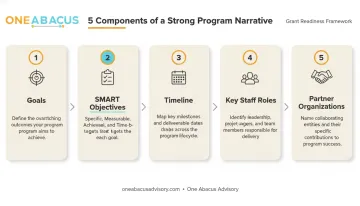
SMART objectives are what funders use to evaluate proposal quality. Weak objectives confuse activities ("we will serve 200 people") with outcomes ("75% of participants will demonstrate improved financial literacy").
Strong objectives focus on measurable change, not just program delivery.
Evaluation Plan
Funders invest in impact and need to see how you'll measure success.
Your evaluation plan should include:
- Quantitative methods: Surveys, pre/post tests, participation counts
- Qualitative methods: Interviews, case studies, focus groups
- Data collection timeline: When and how often you'll gather information
- Analysis approach: How you'll interpret results and adjust programming
Build evaluation into your proposal from the start, not as an afterthought.
Sustainability Plan
Funders don't want to support programs that disappear when their grant ends. Show how you'll sustain the work:
- Diverse revenue streams: Individual donors, earned income, other grants
- Community partnerships: Cost-sharing arrangements and in-kind support
- Transition plan: Phased approach showing how you'll replace grant dollars over time
- Organizational capacity: Existing infrastructure that supports long-term delivery
Grant funding should launch or scale your program, not be its only lifeline.
Writing a Compelling Proposal: Tips and Techniques
Strong proposals are tailored, clear, persuasive, and scannable. Generic boilerplate text is one of the most common reasons proposals fail.
Tailor Every Proposal to the Specific Funder
Mirror the funder's language in your narrative. Reference their stated priorities explicitly. Customize the cover letter and introduction to show you've done your homework.
A proposal written for one foundation and submitted to another without revision shows lack of effort.
Write for an External Audience Using Plain Language
Program staff often write in internal jargon that makes sense to insiders but not to reviewers. Follow plain language principles:
- Use short sentences and everyday words
- Write in active voice
- Avoid acronyms or define them on first use
- Break up dense paragraphs with headings and bullet points
Plain language is not informal or imprecise—it makes proposals easier to evaluate and more professional.
Combine Data with Storytelling
Funders respond to both logic (data) and emotion (narrative). Candid advises that effective proposals feature "staff and clientele as characters" while avoiding becoming a "tedious instruction manual."
Combine a compelling human-interest story about a program participant with supporting statistics. This appeals to both the head and the heart of reviewers.
Format for Easy Scanning
Grant reviewers read dozens of proposals at a time. Make their job easier:
- Headings and subheadings to organize content
- Short paragraphs (3-4 lines maximum)
- Bullet points and numbered lists for key information
- Bold text to highlight critical data points
Before submitting, read your full proposal aloud. You'll catch awkward phrasing, unclear logic, and sections that need tightening.
The Grant Budget: Your Financial Credibility in Writing
The budget is often the first section a funder reviews and serves as a proxy for organizational competence.
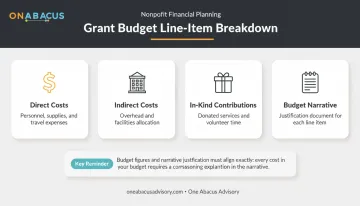
What a Strong Line-Item Budget Includes
- All program revenue and expenses tied directly to the proposed activities
- Direct costs: Personnel (salaries, benefits), supplies, technology, travel
- Indirect costs: Administrative overhead, facilities, general operations
- In-kind contributions: Donated services, volunteer time, space
Every line item must match the program narrative. Budget-narrative misalignment is one of the top five reasons proposals fail initial review.
The Budget Narrative Explains Your Calculations
The budget narrative is a critical companion document that justifies your request. Each line item needs clear explanation:
- How costs were calculated — e.g., "Program Director, 0.5 FTE × $65,000 salary × 1.25 benefits = $40,625"
- How expenses tie to program goals — connect spending to outcomes
- Why the total amount is necessary — defend the full request
Vague or inflated budgets signal poor financial management and damage credibility.
Understanding Indirect Cost Rates
The revised OMB Uniform Guidance (effective October 1, 2024) raised the guaranteed de minimis indirect cost rate from 10% to 15% of modified total direct costs. Federal agencies may not require a rate lower than your negotiated rate or elected de minimis rate.
Nonprofits should update budget templates accordingly and negotiate confidently.
Financial Documentation Quality Matters
Funders cross-check your proposal budget against your 990, audited financials, and organizational operating budget. Inconsistencies raise red flags.
Key documentation practices:
- Ensure budget figures align across all financial statements
- Use board-reviewed, audited financials when available
- Maintain consistent terminology and accounting methods
- Include a sustainability plan showing how you'll replace grant funds after the funding period
Organizations with strong financial infrastructure—including those working with fractional CFO partners—can more easily demonstrate this consistency, which strengthens funder confidence throughout the review process.
Common Grant Writing Mistakes to Avoid
Understanding why proposals fail helps you avoid disqualification and strengthen your submission.
Submission-Level Mistakes
These errors alone can disqualify an otherwise strong proposal:
- Not following formatting instructions (font, word count, page limits)
- Missing the deadline
- Submitting without all required attachments
- Applying for grants your organization is not eligible for
Narrative-Level Mistakes
These weaken proposals and reduce competitiveness:
- Confusing activities with outcomes ("We will serve 200 people" vs. "75% of participants will achieve X")
- Presenting a solution without clearly showing the need
- Over-promising on deliverables relative to budget size
- Generic proposals that copy-paste sections without tailoring to the specific funder
What to Do After a Rejection
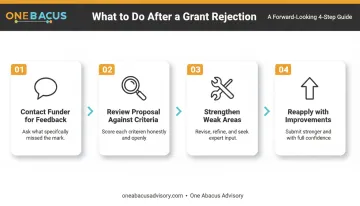
Rejection does not mean your organization is not fundable. GrantStation's 2023 survey found that 88% of respondents received at least one grant award, and many successful grant-funded organizations received multiple rejections from the same funder before being awarded.
The best next step is reaching out to the funder directly for feedback. Ask specific questions:
- What was missing or weak in our proposal?
- How did our application compare to funded proposals?
- Would you recommend we reapply in the next cycle?
Use this information to strengthen your next submission. For instance, if reviewers noted weak outcome measures, work with your program team to develop quantifiable success metrics before reapplying. If budget concerns arose, revisit your cost assumptions and provide more detailed justification for line items.
Frequently Asked Questions
What are the 5 R's of grant writing?
The 5 R's framework covers the complete grant life cycle: Readiness (organizational capacity), Research (identifying aligned funders), Relationships (building funder connections), Writing (compelling proposals), and Reporting (compliance and funder confidence).
What is a typical fee for a grant writer?
Fees vary based on experience, engagement type, and scope. Both the Grant Professionals Association and Association of Fundraising Professionals prohibit percentage-based compensation—members must work for salary, wage, or flat fee.
How long does it typically take to hear back on a grant application?
Timelines vary significantly: private foundations typically respond in 2-4 months, government grants take 6+ months, and some funders provide rolling decisions. Build a grant calendar to track response windows and plan follow-up.
What financial documents do grant funders typically require?
The most commonly requested documents are: IRS Form 990 (three most recent years), most recent audited financial statements, current operating budget, and the IRS 501(c)(3) determination letter. Having these current and accurate before you begin the application saves significant time and strengthens credibility.
What should you do if your grant proposal is rejected?
Contact the funder for feedback, review the proposal against stated criteria, and treat the rejection as a learning opportunity. Many successful grant-funded organizations received multiple rejections from the same funder before being awarded. Use feedback to strengthen your next submission and consider whether relationship-building or organizational readiness improvements are needed.
How do nonprofits stay compliant after receiving grant funding?
Compliance involves meeting reporting deadlines, submitting financial reports, maintaining expense documentation, and adhering to fund restrictions. Strong internal controls and reporting systems are essential for maintaining funder relationships and avoiding audit findings. One Abacus Advisory's grant compliance services help nonprofits build these systems.