This guide walks through the complete nonprofit strategic planning process: who should be involved, the five core stages, key components of the plan, and the often-overlooked financial dimension that determines whether goals are truly achievable.
TLDR: Key Takeaways
- Strategic plans are 3–5 year roadmaps aligning mission, operations, and resources
- Include board members, executive leadership, staff, and external stakeholders in the planning process
- Five key stages: readiness assessment, stakeholder engagement, strategic analysis, plan development, and implementation
- Financial planning determines which goals are feasible and must drive strategy from the start
- Plans fail without accountability — schedule regular reviews and check-ins from day one
What Is Nonprofit Strategic Planning and Why Does It Matter?
Nearly half of all nonprofits operate without a written strategic plan, yet organizations with current plans consistently report stronger outcomes and greater leadership confidence.
Nonprofit strategic planning is the structured process of identifying long-term goals, assessing your environment, and creating a roadmap that aligns resources and programs with your mission. Most plans span three to five years.
Why strategic planning matters more for nonprofits: Unlike for-profit businesses, nonprofits must balance mission-driven priorities with donor accountability, grant compliance, and often limited operational capacity.
The numbers tell the story:
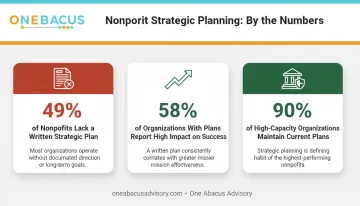
- 49% of nonprofits lack a written strategic plan
- 58% of organizations with plans report high impact on overall success
- High-capacity organizations maintain current plans at nearly 90%, compared to just 70% among low-capacity peers
A strategic plan signals organizational credibility to funders and guides leadership during transitions or growth phases.
BoardSource identifies strategic planning as one of the board's primary responsibilities and recommends refreshing plans regularly.
When to initiate or refresh your strategic plan:
- Your current plan has expired or is nearing completion
- Leadership turnover (new executive director or board chair)
- New funding cycle or major grant opportunity
- Program evolution or mission shift
- Preparation for a capital campaign
- Significant organizational growth or contraction
- External conditions have changed dramatically (economic shifts, regulatory changes)
Who Should Be Involved in Your Nonprofit's Strategic Planning Process?
Choosing the wrong planning participants creates plans that fail in implementation. Too many voices slow decision-making; too few miss critical operational realities.
The right mix balances diverse perspectives with execution efficiency.
Core Planning Committee
Assemble a committee of five to ten people representing these key roles:
- Executive Director/CEO: Provides organizational vision and day-to-day operational insight
- Board Members: Contribute governance perspective and fiduciary oversight
- Department Heads: Representatives from programs, development, finance, and operations bring practical insight into what's feasible
- Frontline Staff: Offer day-to-day reality checks and understand community needs firsthand
External Stakeholders
Beyond your internal committee, The Bridgespan Group's Stakeholder-Engagement Toolkit recommends engaging clients, staff, board members, funders, and community partners.
External voices strengthen your plan by catching internal blind spots and ensuring community relevance.
Structured methods for gathering external input:
- Surveys for broad quantitative feedback
- Facilitated interviews for in-depth qualitative insights
- Focus groups with community members served
- Funder consultations to understand funding landscape realities
Research shows that high-capacity nonprofits engage a larger variety of stakeholders in plan development, which correlates with stronger planning outcomes.
The Facilitator Question
The stakeholder mix you've assembled will need guidance through the planning process. Should you use an internal leader or an external consultant?
External facilitators work best when:
- Board-staff tension requires neutrality
- The organization is navigating significant transition
- Complex decisions need an unbiased voice
Internal leadership suffices when:
- Strong trust exists across the team
- Clear alignment on direction already exists
- Sufficient bandwidth exists to manage the process
The right choice depends on your timeline, complexity, and team dynamics.
The 5 Stages of the Nonprofit Strategic Planning Process
The strategic planning process, while adaptable, reliably follows five core stages. Skipping any one stage tends to produce a plan that lacks buy-in, data grounding, or practical accountability.
Stage 1: Readiness Assessment
Before any planning begins, leadership must honestly evaluate organizational readiness. This means assessing whether the organization has the capacity, data, and culture needed to plan effectively.
Key readiness questions:
- Is there board and executive alignment on the need for planning?
- Do we have accurate financial and program data?
- Is staff bandwidth sufficient to participate meaningfully?
- Are we willing to engage openly with strengths and gaps?
- Do we have the resources to implement what we plan?
Readiness doesn't mean everything is perfect — it means the organization is willing to engage honestly with its current state and committed to making evidence-based decisions. Once readiness is confirmed, the organization can move forward with gathering stakeholder input.
Stage 2: Stakeholder Engagement and Data Gathering
Discovery begins with listening sessions, surveys, and interviews with internal and external stakeholders. This process identifies organizational perceptions, community needs, and funding landscape realities.
Gather both qualitative and quantitative data:
- Qualitative: Stakeholder perceptions, community feedback, staff insights, funder priorities
- Quantitative: Financial trends, program outcomes, donor retention metrics, peer benchmarking
This stage should answer: What do our stakeholders value? What challenges do they see? What opportunities exist? What data reveals our true organizational health? These answers provide the foundation for strategic analysis.
Stage 3: Strategic Analysis
The SWOT analysis (Strengths, Weaknesses, Opportunities, Threats) is the standard framework for synthesizing discovery findings. However, research shows that while SWOT is the most commonly used pre-planning technique, it ranked last in effectiveness. Programs and services assessment ranks as most effective.
Nonprofit-specific analysis should include:
- Programs and Services Assessment: Evaluate effectiveness, scalability, and cost-efficiency of each program
- Business Model Review: Examine revenue sources, financial stability, and organizational capacity
- SWOT Summary: Synthesize strengths, weaknesses, opportunities, and threats into strategic implications
This stage surfaces the hard trade-offs leadership must make. Not every program can continue, and not every opportunity can be pursued — strategic analysis forces prioritization based on evidence, not sentiment.
Stage 4: Developing the Strategic Plan
Insights from the analysis phase translate into three to five strategic priorities — focused enough to be actionable, broad enough to guide multi-year decisions.
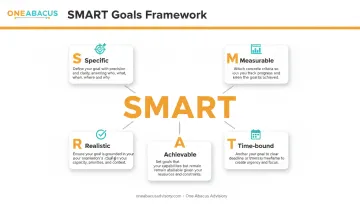
Goals should meet SMART criteria:
- Specific: Clear, well-defined outcomes
- Measurable: Quantifiable indicators of success
- Achievable: Realistic given resources and capacity
- Realistic: Aligned with mission and organizational capabilities
- Time-bound: Clear deadlines and milestones
Each goal must be accompanied by clear metrics, assigned ownership, and a realistic budget. These elements get documented in the final written plan.
Typical structure of the final written plan:
- Executive summary
- Mission, vision, and values
- Current state summary (SWOT and analysis findings)
- Strategic priorities and goals (3-5 priorities)
- Action plans and tactics for each goal
- Success metrics and KPIs
- Timeline and milestones
- Budget tied to priorities
Stage 5: Implementation, Monitoring, and Plan Refresh
The plan becomes a living document — not a one-time deliverable. Research shows that 48% of organizations fail to meet at least half of their strategic targets, primarily due to poor communication, vague goals, and lack of accountability.
Best practices for implementation:
- Integrate strategic priorities into board meeting agendas
- Conduct quarterly or semi-annual progress reviews
- Build in a formal annual check-in to assess whether goals, metrics, or priorities need updating
- Assign clear ownership for each priority with accountability structures
High-capacity organizations review plan progress quarterly and discuss updates in executive and board meetings. Regular monitoring prevents "plan fatigue" and keeps accountability structures intact.
Key Components Every Nonprofit Strategic Plan Should Include
Every complete nonprofit strategic plan should contain these essential building blocks.
Mission, Vision, and Values
Clarify the distinction:
- Mission statement: Defines current purpose and impact (what you do, for whom, and why)
- Vision statement: Describes the future the organization is working to create
- Core values: The principles that guide how the work gets done
If these already exist, the planning process should include a deliberate review to confirm they still reflect organizational reality and direction.
SWOT Analysis Summary
Your strategic plan document should include a clear, concise presentation of SWOT findings — not just the raw data, but the strategic implications drawn from it.
This section demonstrates to board members and funders that the organization made evidence-based decisions about priorities.
Strategic Goals and Action Plans
Based on your SWOT findings, identify three to five strategic goals spanning the plan period. Each goal needs specific action plans that include:
- The initiatives and tactics that will achieve each goal
- The teams or individuals responsible
- A phased timeline with milestones
- Resource requirements and dependencies
Too many goals weakens focus. Fewer, well-resourced goals drive stronger outcomes.
Metrics, KPIs, and Budget
Every goal must have measurable indicators of success — not just narrative descriptions of intent. Include a financial budget that ties strategic priorities to resource allocation, ensuring the plan is operationally grounded rather than purely aspirational.
Key financial components:
- Multi-year budget projections aligned with strategic priorities
- Revenue assumptions and diversification strategies
- Cash flow forecasting
- Reserve targets and sustainability metrics
How Financial Planning Anchors a Strong Nonprofit Strategy
The most commonly overlooked reality in nonprofit strategic planning: a goal without a financial model behind it is a wish, not a strategy.
Financial analysis — including multi-year budget projections, reserve levels, revenue source diversification, and cash flow forecasting — should be built into the strategic planning process, not completed after the plan is written.
The Nonprofit Finance Fund's 2025 State of the Nonprofit Sector Survey found that 36% of nonprofits ended 2024 with an operating deficit — the highest in 10 years. Meanwhile, 52% hold three months or less of cash on hand.
The Public Support Test and Revenue Diversification
The IRS requires 501(c)(3) public charities to receive at least one-third (33.3%) of their support from contributions from the general public to maintain public charity status under IRC Section 509(a)(1). Over-reliance on a single revenue source can put that status — and financial stability — at risk.
Research from Candid found that approximately one-third of government grantees depend on those funds for more than 50% of total revenue, and 84% of nonprofits receiving government funding expect cuts.
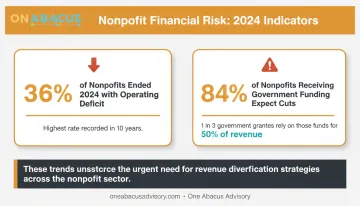
This makes revenue diversification a strategic imperative, not just a financial management task.
Financial Data Must Inform Strategic Priorities
Your financial data reveals the truth about program sustainability. If a program is mission-aligned but financially unsustainable, the plan must address that tension explicitly — either through a funding strategy, a scope adjustment, or a planned phase-out.
Finance and strategy cannot be developed in separate silos.
Financial planning should answer:
- Which programs generate net revenue vs. require subsidy?
- What funding sources are most reliable and least restrictive?
- How much runway do we have if a major funder exits?
- What reserve levels do we need to weather disruption?
- Can we afford the staffing required to execute this strategy?
The Role of Fractional Financial Leadership
Many nonprofits — especially mid-sized organizations — lack the in-house CFO capacity to conduct the financial modeling that effective strategic planning requires. Nonprofits typically consider fractional CFO services when their annual budget reaches $500,000 to $2 million, with monthly retainers typically ranging from $2,000 to $7,000.
A full-time CFO is usually not hired until an organization's budget exceeds $10 million, with salaries ranging from $150,000 to over $250,000 annually.
A fractional CFO partner, like One Abacus Advisory, can provide board-ready financial analysis, scenario modeling, and ongoing oversight to ensure strategic goals remain financially viable throughout the plan period — without the cost of a full-time executive hire. This approach gives organizations access to executive-level financial expertise for budgeting, forecasting, cash flow management, and strategic planning support exactly when they need it.
Best Practices and Common Pitfalls to Avoid
Best Practices
Keep the plan focused:
- Three to five strategic priorities maximum — not a wish list
- Each priority should be substantial enough to guide multi-year decisions
- Resist the temptation to include every good idea
Assign clear ownership:
- Every goal needs a named owner (staff or board member)
- Define accountability structures and reporting cadences
- Build ownership into job descriptions and board committee charters
Communicate broadly:
- Share the plan with all staff and board members, not just leadership
- Create accessible summaries for different audiences
- Use the plan as an onboarding tool for new team members
Connect to operations:
- Integrate strategic priorities into annual budgets and work plans
- Reference the plan in board meetings and staff reviews
- Use it as a decision-making filter for new opportunities
- Partner with financial leadership—whether in-house or fractional—to ensure priorities align with budget realities and cash flow projections
Even well-intentioned planning efforts can falter. Watch for these common missteps:
Common Pitfalls
Over-reliance on a single major funder:
- Develop a diversification strategy that targets 3-5 revenue streams within two years
- Monitor revenue concentration annually
- Build contingency plans for funding disruptions
Setting goals without budget allocation:
According to research on nonprofit strategic planning practices, 60% of organizations do not tie their financial budgets to strategic priorities. Every strategic goal must have a corresponding budget line, because resource allocation reflects true organizational priorities.
Excluding frontline staff and community voices:
- Isolated planning processes lack operational grounding
- Staff buy-in is essential for implementation success
- Community input ensures relevance and impact
Failing to schedule formal review cycles:
Almost 25% of organizations review strategy implementation only once per year. Quarterly reviews catch when circumstances change, while annual check-ins allow for course corrections.
The Living Document Principle
A strategic plan that isn't revisited is a failed plan regardless of how well it was written.
Maintain momentum through:
- Board strategy committee with quarterly review authority
- Dashboard reporting that tracks progress against key milestones
- Annual reassessment cycles that allow course corrections
- Integration into executive and board meeting agendas
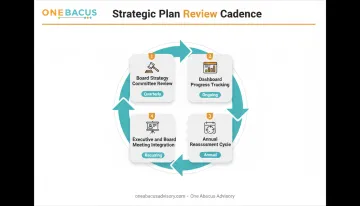
High-capacity organizations treat planning as a routine periodic process, enabling them to be proactive rather than reactive.
Frequently Asked Questions
What are the 5 stages of strategic planning?
The five stages are: (1) readiness assessment, (2) stakeholder engagement and data gathering, (3) strategic analysis including SWOT, (4) plan development with SMART goals and budget, and (5) implementation with ongoing monitoring.
What are the 5 P's of strategic planning?
The 5 P's framework consists of Plan (deliberate course of action), Ploy (tactics to address challenges), Pattern (consistent behaviors), Position (organizational differentiation), and Perspective (guiding mindset).
What are the 5 C's of strategic planning?
The 5 C's are Company (internal capabilities), Collaborators (partners and funders), Customers (beneficiaries served), Competitors (peer organizations), and Context (external conditions and trends).
What is the 33% rule for nonprofits?
The 33% rule relates to the IRS public support test for 501(c)(3) status. Organizations must demonstrate that at least one-third of their support comes from public sources to qualify as a publicly supported charity under IRC Section 509(a)(1).
How often should a nonprofit update its strategic plan?
Most nonprofits operate on three to five year strategic plans, with annual reviews to assess progress and adjust priorities based on funding, leadership, or community changes.
How long should the nonprofit strategic planning process take?
The full process typically takes three to six months from readiness assessment through board approval. Timeline depends on organizational size, stakeholder availability, and whether you're using internal or external facilitation.
Ready to build a strategic plan anchored in financial reality? One Abacus Advisory provides fractional CFO services that integrate financial modeling, scenario planning, and board-ready analysis into your strategic planning process — giving you executive-level financial leadership without the cost of a full-time hire. Contact us at 760-845-3808 or lorin@oneabacusadvisory.com to discuss how we can support your organization's strategic planning journey.